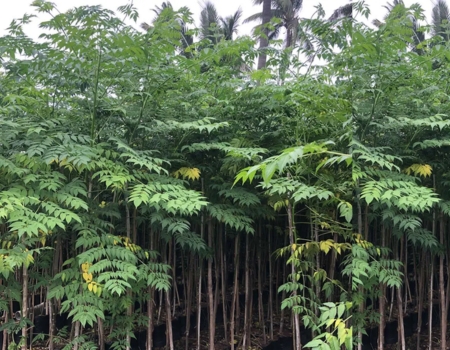
Organic Melia Dubia
Melia Dubai is a money spinning tree of short duration. Block planting of 440 trees per acre can ensure a min. Profit of 8 Lakh 80 Thousand every 7th year from an acre. Intercultivation can be done with annual crops in the first 7th year and then spices such as pepper can be grown. Production will be in every 7th – 7 th year and Total 7 time’s production in 49 years. A large tree, attaining a height of 20 m. with a spreading crown and a cylindrical straight bole of 9 m. length X 1.2-1.5 m. girth found in Sikkim Himalayas, North Bengal. Upper Assam, Khasi Hills, hills of Orissa, N.Circas, Descant and Western Ghats at altitudes of 1500 – 1800 m. It grows rapidly and is used for reforestation purposes. (Troup, I 186: Bur kills, II 1443: Bor, 253) and yields a useful timber.
Send EnquiryUsage:
As the demand for Melia Dubai wood is quite high from the plywood industry, minimum profit about Rs.8,00,000 per 7th year from an acre can be ensured for the farmers regarding pest infestations affecting this variety is susceptible to root rot. Only optimum irrigation is required. While planting the seedling application of 2-3 kg of vermicompost, 40 gm of phosphobacteria, azospirillum and trichoderma viride each in addition to 10-20 gm of pseudomonas and 100 grams of vamps helps in promoting good growth. The wood is used for packing cases, cigar boxes, ceiling planks, building purposes, agricultural implements, pencils, math boxes, splints and catamarans. In Sri lanka, it is employed for outriggers of boats. It is suitable for musical instruments, tea boxes and the most importantly in making plywood, as the wood is anti-termite by itself.
Site Factor And Topography:
In its natural habitat the absolute maximum shade temperature varies from 37.5–47.5 C and the absolute minimum from 0–15 C. It does well in moist regions, with a mean annual rainfall exceeding 1000 mm. The mean relative humidity in July varies from 70–90% and in January from 50–80 %. It is commonly found in the hills at elevations ranging from 600 – 1800 m.
Cultivation:
The rooted saplings are planted onset of the monsoon or during the monsoon. The suggested pit size is 2’ x 2’- 0.60m Cube. Escapement of 3.5 m x 3.5 m is recommended. This will give better girth in shorter duration.
Growth Statistics:
The growth is rapid. GAMBLES’s specimens gave 8 – 12 rings/dm of radius (mean annual girth increment 5.3 – 8 cm) for a Tamil Nadu specimen, and 28 rings/dm( mean annual girth increment 2.3 cm) for a specimen from Bengal. North Kanara in Karnataka specimen showed 12-16 rings/dm of radius (TALBOT, 1909) giving a mean annual girth increment of 4 –5.3 cm. Trees grown in the Calcutta Botanical gardens from specimen from Malbar origin are said to have reached in 7 years an average height of 14m and a girth of 112 cm at breast height. This rate of growth is equivalent to 4-rings/ dm of radius. Even in comparatively dry regions with a rainfall of 750 – 1000 mm, a height of 3 – 4.5 m is obtained in plantations, against 6-7.5 m in more favorable locations.
Utilization:
The sapwood is grayish-white, usually with a yellowish cast; the ‘ heartwood ’ is light pink to light red when first exposed, ageing to pale russet brown, subject to grey stain. It is lustrous and without characteristic odor or taste. Coarse and somewhat uneven-textured. Annual growth rings are distinct but not conspicuous and number 12-16/ dm of radius.
Seasoning And Preparation:
The timber seasons well if the logs are converted in a green state, though if left long in the log, it is liable to develop end splitting and decoration. Like many other malicious timbers, it contracts very considerably across the grain while drying out. The best method of dealing with the timber is to convert the logs as soon after falling as possible and to open stack the sawn material, preferably undercover to avoid grey stain.
Quality And Technical Specifications:
(1) The logs had very high moisture contents and were green.
(2) All logs were round and good for peeling. Roundness seems to be inherent quality of this
tree.
(3) Logs peel easily.
(4) Outturn is excellent – 70% & better in fresh cut logs.
(5) Veneer strong and firm.
(6) Two small logs were peeled for faces. Quality obtained was acceptable.
(7) M.R.Grade Plywood pressed with these veneers and in combination with other veneers gave
excellent results.
(Pearson & Brown, I 243; Macmillan, 96, 213; Cameran, 64; Trotter, 1944, 217; Rama Rao, 73;
Indian For., 1948, 74, 279).


